Okosama Sacred Child Status
The Character of RainOkosama Sacred Child Status is the special standing the narrator experiences as a child in Japan before nursery school: she is treated not merely as young, but as a little god whose wishes command unusual care. In her account, the status is made tangible by Nishio-san’s acts of service and adoration. It gives the narrator a place in a household and a culture, and becomes the foundation for her sense of herself as divine. Its force is also limited: turning three, and the prospect of nursery school, signal that this exceptional state will end.
Definition and Developmental Setting
The narrator describes a Japanese custom under which a child remains a god from birth until entering nursery school. She calls this condition Okosama Sacred Child Status and understands its honorific quality through the treatment she receives: she is addressed and indulged as an exceptionally important child, while older children are treated in an ordinary way. The status is therefore tied both to age and to a social threshold; it is not presented as a privilege that lasts indefinitely.
This childhood identity takes shape in Kansai, in the village of Shukugawa, when the narrator is two and a half. Its background is a striking reversal in how adults respond to her. Specialists had called her condition pathological apathy and recommended hospitalization, while her parents declined to follow that advice. They already had two older children who were full members of the human race, and the idea of having a third child who was a vegetable nonetheless prompted tenderness. The parents called the infant the Plant. By the time the narrator describes her life as a Japanese child, she has moved from being regarded as inert to receiving the focused affection of a caregiver who treats her as extraordinary.
The contrast is sharpened by the adults’ expectations of development. At two, the narrator had neither tried to crawl nor made a sound, and the adults around her interpreted this as a developmental blockage. Her later account of sacred childhood does not erase that history; it places her privileged status after a period in which others struggled to classify her. The book thus sets adult judgments about what a child should be able to do beside the narrator’s own account of the identity she came to inhabit.
Nishio-san’s Care and the Household
Nishio-san gives the status its daily form. In the morning, when the narrator comes into the kitchen, Nishio-san bends down to her height and gives her what she asks for. If the child wants food from Nishio-san’s plate, she is allowed to take as much as she pleases; Nishio-san waits to eat until the child has finished, even when little or nothing remains. The arrangement turns ordinary acts of feeding into a visible declaration of precedence.
The meals also distinguish Nishio-san’s kitchen from the parents’ dining room. The narrator nibbles at the meal with her parents so that she can leave room for the second meal with her nanny. Nishio-san’s okonomiyaki, a cabbage pancake with shrimp and ginger, and tsuke-mono rice appeal more to her than pureed carrots with small pieces of meat. When Mother sees the child taking food from Nishio-san’s plate, she scolds her and asks Nishio-san not to let herself be tyrannized. The intervention does not change the routine: as soon as Mother turns away, the narrator resumes it.
The narrator makes the difference in treatment decisive. Her parents treat her as they treat the other children; Nishio-san treats her as a god. Choosing between these forms of care, she says in retrospect, is scarcely a choice at all. Her devotion to Nishio-san is not an abstract response to a cultural idea: it grows out of repeated, particular experiences of being fed first, indulged, and made the focus of attention.
Identity, Belonging, and Adoration
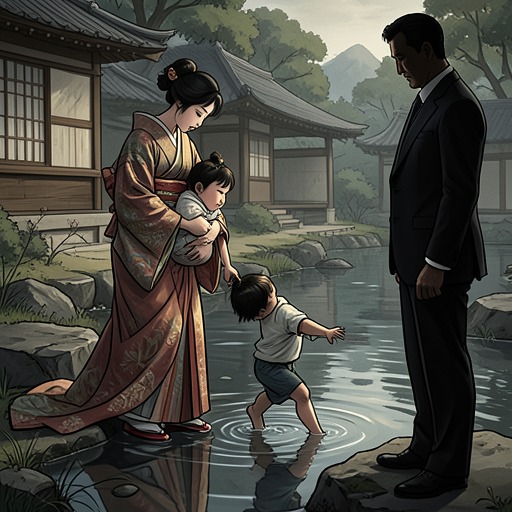
The narrator describes her attachment to Nishio-san as part of becoming Japanese. Japan, in this recollection, is associated with beauty and adoration: the odor of flowers in a garden moistened by rain, a pool with distant mountains beyond it, and the twilight song of the yam seller passing through the neighborhood. These impressions belong to the narrator’s account of what Japanese life meant to her at that age, rather than to a neutral definition of Japanese identity. At its center is being Nishio-san’s chosen one.
Nishio-san is ready to put aside her work, take the narrator into her arms, and sing to her about gardens and blossoming cherry trees. She also tells stories of bodies cut to pieces and of a witch cooking people in a cauldron; the narrator listens in stunned silence. When the child pretends to be hurt, Nishio-san joins the game, consoling her for suffering that does not exist. She traces the child’s features with a finger and praises her mouth, forehead, and cheeks, declaring that she has never seen a more beautiful face. The narrator calls Nishio-san a good person and recalls that she never tired of being held in her arms. Nishio-san’s adoration serves as proof, in the child’s understanding, of the solidity and excellence of her divine self.
This relationship also explains why the narrator sides with the nanny rather than with the parents’ more equal treatment of the children. The status is not simply bestowed by an adult convention and accepted passively: the narrator recognizes which relationship sustains it and repeatedly returns to that source of care. Her declaration that she would become Japanese follows from a lived attachment—to Nishio-san, her household, and the forms of beauty and attention she associates with them.
The Age Limit and Retrospective Meaning
The status has a sharp boundary. The narrator presents the Japanese understanding of the third birthday as marking the end of the divine state. Turning three brings no good in her account: something precious is lost, especially the belief that the world is good. She has heard that she will soon be sent to a Japanese nursery school and cannot accept the prospect of leaving her garden to join a group of other children. The institution that ends the sacred interval is therefore also the immediate threat to the world in which she has been cherished as unique.
Her account gives this fear a particular relation to age and memory. At two, she says, a child does not notice seasonal changes; at four, remembered seasons lessen their drama. At three, the child sees everything but understands nothing, without a precedent to consult or confidence that adults know more. The narrator’s alarm at the approaching end of her protected state belongs to this same condition of intense perception without explanation. The changes in the garden and the prospect of nursery school are not yet parts of a settled cycle; they feel irreversible.
The adult narrator also makes the limits of her recollection explicit. She says that she remembers everything after February 1970, though she knows the claim cannot be proved or disproved and does not insist on being believed. Before White Chocolate, she remembers nothing directly and must rely on other people’s accounts; afterward, she says, what she knows is firsthand. This distinction matters to the presentation of Okosama Sacred Child Status: the remembered scenes of Nishio-san’s care are offered as the narrator’s own memories, while the earlier history of the motionless child comes through a different relation to knowledge. The status endures in the narrative not as a permanent social rank, but as a vivid childhood identity shaped by devotion, bounded by nursery school, and recovered through the narrator’s account of memory.